
13th Century Undercroft shop
HeritageBeneath the Cobbles: The 13th Century Undercroft at 72 High Street, Guildford
Step down from Guildford's sloping High Street, through a narrow stone doorway that has stood since the reign of Edward I, and the modern town vanishes. The air cools. Traffic noise fades into silence. Your eyes adjust to the half-light filtering through a low medieval window, and suddenly you are standing inside one of the finest surviving medieval shop cellars in England — a rib-vaulted chamber that has endured for more than seven hundred years beneath the everyday bustle of a Surrey market town.


A Merchant's Ambition in Stone
The Undercroft at 72/74 High Street dates to the late thirteenth century — a period when Guildford was flush with wealth from the wool trade. The North Downs provided grazing land for sheep, local deposits of Fuller's earth fuelled the fulling mills along the River Wey, and the town had built a reputation for manufacturing kersey, a coarse woollen cloth dyed and sold across the country as "Guildford Blue." In 1257, Henry III had granted the town its first borough charter, cementing its status as a commercial centre of real significance.
It was in this prosperous climate that an unnamed merchant — probably a dealer in wine, imported silks, or fine textiles — commissioned a stone-vaulted cellar beneath his timber-framed house on the High Street. Masonry construction of this quality was extraordinarily expensive. Only the wealthiest traders could afford it, and the Undercroft's very existence tells us that Guildford's medieval merchant class was playing at a level far above a typical market town. There were once roughly a dozen similar undercrofts along the High Street. This is the only one that survives fully intact.

Reading the Stones
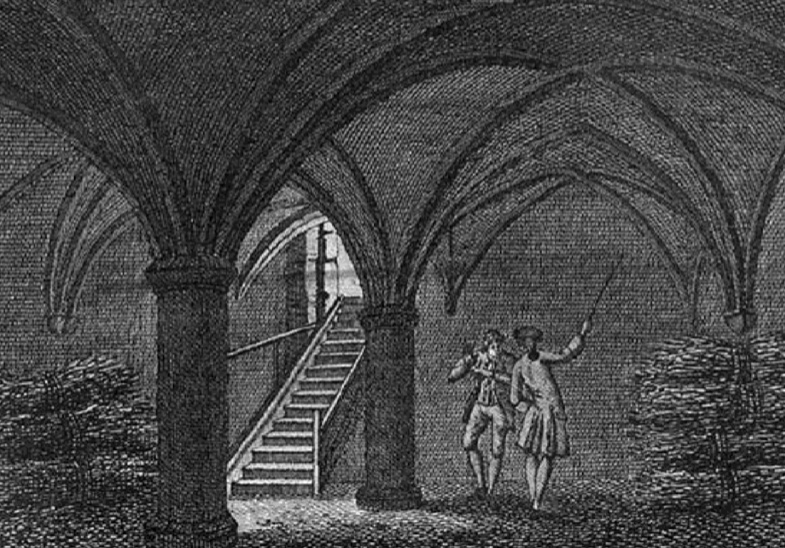
The Undercroft measures roughly thirty feet long by nineteen wide and nine feet high — intimate enough to feel like a private space, grand enough to impress a customer. Two stout round columns rise from the floor, their capitals supporting a rib-vaulted ceiling that fans outward in three elegant bays. The masonry is confident, almost showy: this was never a rough storage pit, but a room built to display goods and close deals.
Look up at the corbels where the vault ribs meet the walls and you will find carved grotesque faces staring back — medieval humour frozen in stone. One, near the entrance steps, depicts a woman wearing a wimple, the fitted head-covering fashionable among well-to-do women of the late 1200s. It is a small, human detail that collapses the centuries: someone chose that face, a mason carved it, and here it remains, watching visitors descend the same steps that merchants' customers once trod.

.jpg)
The entrance itself is a piece of clever medieval engineering. Positioned on the downhill side of the High Street, the doorway exploits the natural slope to give maximum headroom where it matters most — at the threshold. On the uphill side, a low window lets in just enough daylight to illuminate the wares without flooding the room. A narrow internal doorway once led to a spiral staircase connecting the shop to the merchant's living quarters above. It is a complete commercial unit, designed with the same care a modern retailer might give to a flagship store.
Centuries of Silence
By the fourteenth century, the Undercroft's days as an active shop were over. The wool trade that had enriched Guildford began to shift, and the vaulted room was repurposed for storage — wine barrels, perhaps, or household goods. The centuries rolled on. Above, the original timber-framed house was pulled down in 1803 and replaced with the three-storey red brick building that stands today. But beneath the floorboards, the medieval chamber endured, sealed and largely forgotten.
For much of the twentieth century, the Undercroft sat empty, its street entrance bricked up, its existence known only to local historians and the occasional curious council officer. It was not until 1989 that the blocked doorway was finally reopened and the room restored. The timing was fitting: Guildford was rediscovering its heritage, and here, hidden in plain sight on the busiest street in town, was one of the most complete medieval merchants' cellars in the country.

What Survives — and Why It Matters
The Undercroft holds dual protection as both a Grade II* listed building and a Scheduled Monument — a rare combination that reflects its national importance. It is managed today by Guildford Museum, itself founded in 1898 by the Surrey Archaeological Society, whose collections span from Lower Palaeolithic tools half a million years old to objects of the modern era. Together, the Museum and the Undercroft form a layered record of human life in this corner of Surrey.
What makes the Undercroft exceptional is not just its age, but its completeness. Medieval undercrofts survive in fragments across English towns — a wall here, a column there — but the Guildford example retains its vaulting, its columns, its carved corbels, and its original street entrance. It is an intact room from the thirteenth century, sitting beneath a working high street, free to enter and open to anyone willing to walk down a flight of stone steps.
Visiting
The Undercroft is open on Wednesdays and Saturdays from May to September, and on Wednesday afternoons from October to April. Admission is free. There is no lift — access is via the original medieval steps from the High Street — but the descent is short and the reward is considerable. Guildford Museum, a short walk away in the Castle grounds, provides wider context for the town's long and layered past.
This article was partly inspired by old photographs and personal recordings that came to light when someone brought their family memories to be digitised — images and reels that turned out to have unexpected connections to Guildford's historic streets. It made us wonder what else might be out there, in attics, shoeboxes, and old cupboards, connected to places like the Undercroft and the communities that have gathered around them for centuries. If anyone holds old media connected to this or any heritage organisation, services like EachMoment can help preserve them for future generations.